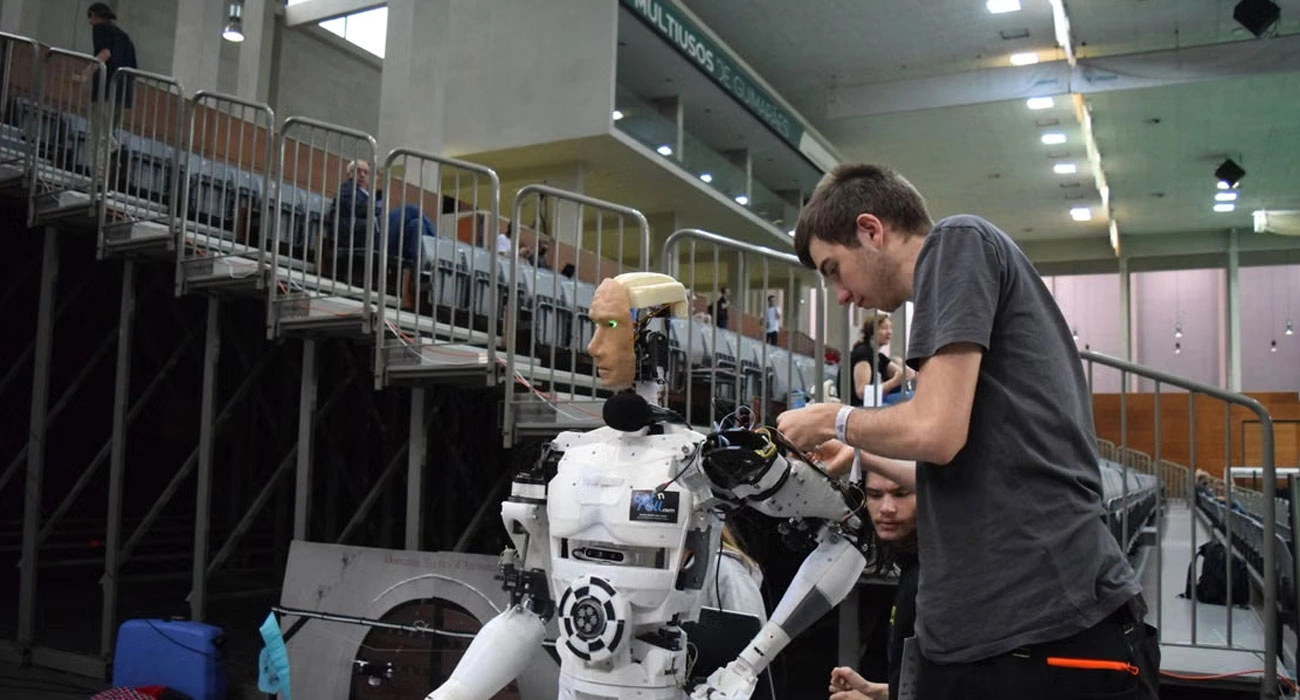
Humanoid robots have spent the past few years winning attention through impressive demonstrations. Now they are entering a less glamorous but more important stage: proving the business case.
The humanoid-robot industry is shifting from showcasing technological capabilities to demonstrating commercial viability. While impressive demonstrations have garnered global attention, the focus is now on whether these robots can provide genuine value in practical applications. This transition is crucial as investors and regulators demand concrete proof that humanoid robots can operate effectively in real-world scenarios, leading to sustainable revenue streams.
As the industry matures, it's essential for companies to highlight specific use cases where humanoid robots can enhance efficiency, reduce costs, or perform tasks that are challenging for human workers. This new emphasis on business cases represents a significant shift in how the robotics sector is perceived, moving away from merely showcasing capabilities to proving economic relevance.
China has emerged as a leading player in the humanoid robotics sector, driven by state support and a vibrant tech ecosystem. Government initiatives have fostered innovation and investment in robotics, allowing companies to experiment and develop advanced technologies. As a result, Chinese firms have made significant strides in humanoid robot development, positioning the country as a global leader in this field.
However, the rapid growth has also led to challenges, including inflated valuations and unsustainable revenue expectations. The current regulatory environment aims to address these concerns by demanding greater transparency and proof of commercial demand, thus ensuring that only viable projects receive backing.
Recent developments indicate that Chinese regulators are slowing down the initial public offering (IPO) process for humanoid robotics companies. This shift stems from concerns surrounding the volatility of valuations and the reliance on government-backed projects, as seen in the case of Unitree Robotics. Investors are now prioritizing companies that can demonstrate real order volumes, deployments, and commercially viable use cases over mere technological demonstrations.
This reality check is significant as it may lead to a more sustainable growth trajectory for the sector. Companies that can prove their robots have practical applications and can deliver measurable results will likely be at the forefront of future developments in humanoid robotics.
To establish commercial proof, humanoid robotics companies must focus on tangible metrics such as order volumes, deployment rates, and customer satisfaction. Investors are looking for evidence that these robots can not only perform tasks but also deliver a return on investment. This involves showcasing successful case studies where humanoid robots have positively impacted businesses by increasing efficiency or reducing labor costs.
As the industry evolves, companies will need to cultivate partnerships with businesses across various sectors to demonstrate the practical applications of humanoid robots. This collaborative approach will not only enhance credibility but also foster innovation within the robotics ecosystem.
Facts & Insights
- Chinese regulators are reportedly slowing new humanoid-robot IPO activity amid concerns about valuations and the sustainability of reported revenues.
- Unitree Robotics experienced significant share-price volatility after its IPO, contributing to increased scrutiny of the sector.
- China continues to identify embodied intelligence and humanoid robotics as strategic technology sectors despite the increased scrutiny.
3+
Major Robot Developers
1
Commercialisation Test
2
Core Questions: Orders + Deployment
2026
Reality-Check Year
“
”
The next test for humanoid robots is no longer whether they can move. It is whether someone will pay for them to do it.
— Editorial framing
Humanoid robotics does not need to fail for the industry to mature. In fact, greater scrutiny may be one of the signs that the technology is entering a more serious phase. Demonstrations can prove that a machine is capable of performing a task; commercial deployment must prove that doing so is valuable enough to justify the cost.
This distinction will increasingly shape which robotics companies receive capital, which applications move into factories and workplaces, and which ideas remain prototypes. BritishPEDIA's Showcase can document this transition as a defining moment in the evolution of AI when technological possibility begins meeting the harder discipline of economic reality.