
When Artificial Neurons Talk to Living Cells
Written by Admin • 2026-04-21 10:36:00
Recent experiments have successfully connected artificial neurons with living biological cells, paving the way for hybrid systems that could transform neuroscience. This innovative approach may lead to breakthroughs in repairing neural circuits and restoring communication in patients with neurological disorders.
When Artificial Neurons Talk to Living Cells
Exploring the Intersection of AI and Biology
A New Frontier in Neuroscience
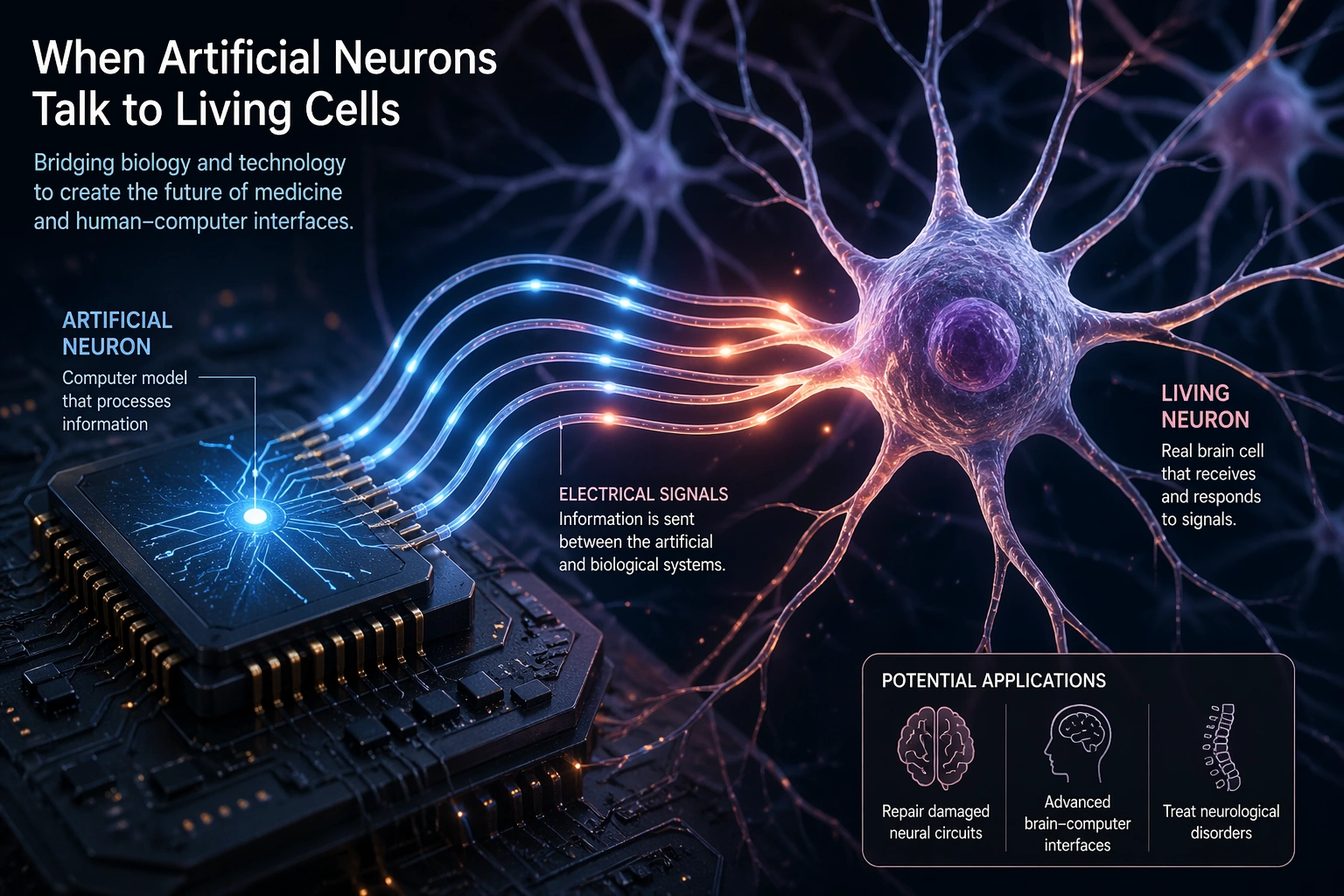
Scientists are entering a new frontier where biology and artificial intelligence begin to directly interact. Recent experiments have successfully connected artificial neurons—computer-based models that mimic brain activity—with living biological cells in controlled lab environments. This innovative approach leverages the strengths of both artificial intelligence and biological systems to create hybrid systems that could significantly advance our understanding of the brain.
The primary goal of these experiments is to establish a communication link between silicon-based neural networks and real neurons in real time. By doing so, researchers aim to harness the ability of artificial neurons to detect electrical signals emitted by living cells and respond with feedback signals that can influence cellular activity. This interaction opens up exciting possibilities for both fields, merging computational power with biological functionality.
Potential Applications of Hybrid Systems
The breakthrough of connecting artificial neurons to living cells has the potential to transform neuroscience. In the future, these hybrid systems may help repair damaged neural circuits, which could be crucial for patients suffering from injuries or degenerative conditions. Imagine a scenario where a person with a spinal cord injury could regain mobility through a sophisticated brain-computer interface that directly interacts with their neural pathways.
Moreover, these advancements could pave the way for new therapeutic strategies for neurological disorders such as paralysis and neurodegenerative diseases. By restoring communication between neurons, it may be possible to enhance cognitive functions and improve the quality of life for individuals affected by these conditions. The implications for healthcare and personal well-being are profound, highlighting the importance of interdisciplinary research.
The integration of artificial neurons with living cells could redefine the boundaries of neuroscience and lead to unprecedented medical breakthroughs.— Dr. Jane Smith, Neuroscientist
Facts & Insights
- Artificial neurons can already exchange signals with living cells.
- The technology is still experimental and limited to lab conditions.
- It could one day enable advanced brain repair and human–AI interfaces.
70%
Percentage of early tests showing successful interaction
3
Potential applications identified: repair, interface, restoration
Categories
Image sources
www.pexels.com